
What We Can’t See From the Front of the Room

Speaker delivering keynote from a stage looking at audience.
I received a piece of feedback after a recent keynote that stopped me in my tracks.
I had just delivered Turn Your Battle Scars into Badges of Honor, a deeply personal keynote about resilience, perseverance and what happens when life takes an unexpected turn. The audience was made up of public health association members looking for new perspectives on tackling burnout.
Afterward, an attendee shared this with me:
“I appreciated the presentation and the message. I wish there had been a content warning for child loss for folks in the room to prepare themselves if needed.”
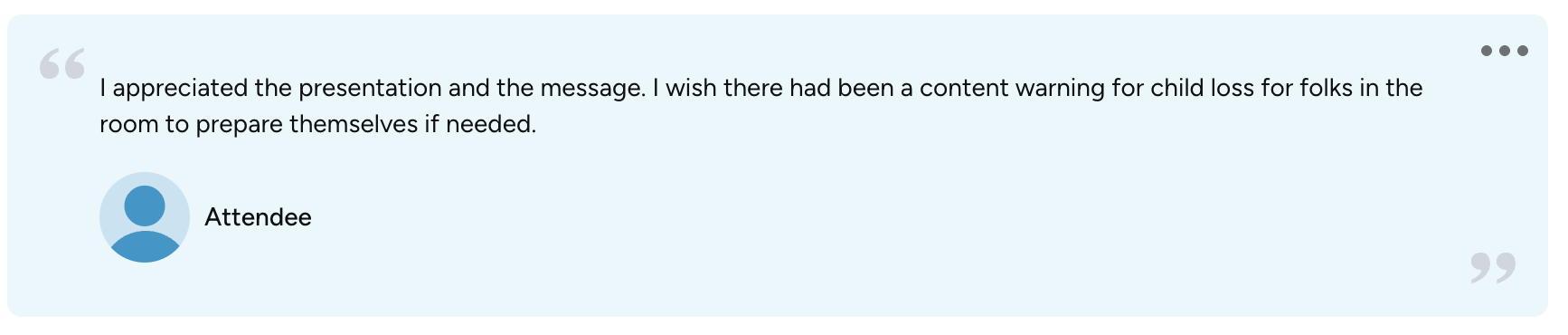
Testimonial from recent keynote at a public health association conference.
I sat with that comment.
As a professional speaker, I spend a lot of time thinking about what happens in the room. Are people engaged? Are they laughing? Are they taking notes? Are they leaning in? Are they connecting with the person next to them?
But this feedback reminded me of something equally important: What about the things we can’t see?
We can't see the experiences people carry into the ballroom with them. We don't know who is grieving. Who received difficult news that morning. Who is struggling at work. Who is caring for a parent. Who has experienced the very thing being described from the stage.
And that may be one of the most important considerations for association leaders as we design conferences and member experiences for 2027 and beyond.
Your Audience Arrives With More Than a Name Badge
Professional speakers have an unusual vantage point. We speak at dozens of association events, conferences, and corporate meetings. We watch audiences walk into ballrooms at 8 a.m. with coffee in one hand and a phone in the other. We see the post-lunch energy dip. We know when a room is genuinely engaged and when attendees are politely waiting for the session to end.
We also hear things backstage, in elevators and during hallway conversations that may never appear on the official conference evaluation. And one thing has become increasingly clear: People aren't just looking for more content. They're looking for more meaningful experiences.
That distinction matters.
For years, associations have understandably focused on delivering value by adding things: more sessions, more resources, more networking opportunities, more benefits.
But more doesn't automatically equal better.
Your members already have access to an almost limitless amount of information. They can find an article, watch a webinar, listen to a podcast, take an online course or ask an AI tool to explain a concept in seconds. Information itself is no longer the scarce commodity. Connection is.
Welcome to what I call The Connection Economy, an environment in which our ability to create trust, belonging, relationships and meaningful human interaction increasingly determine whether people believe an experience was worth their time. That has enormous implications for associations.
Stop Asking Only: “What Should We Put on the Agenda?”
Of course, content matters. Your members expect expertise, relevance and practical takeaways.
But perhaps the additional planning question is: How do we want people to experience this event? Those are two very different questions. The first produces an agenda, a run-of-show. The second produces an experience.
From the stage, I notice when organizers have thought about that distinction. It shows up when an emcee doesn't simply read speaker bios but helps connect the dots between sessions. It shows up when networking isn't treated as the 20 minutes before lunch but is intentionally designed into the event. It shows up when attendees have opportunities to talk with one another rather than spending eight hours being talked at. It shows up when there is enough breathing room in the schedule for someone to have the conversation that becomes the most valuable part of the entire conference.
And increasingly, it also means thinking about the emotional experience we're creating.
Psychological Safety Belongs in Event Design, Too
That attendee's comment about my keynote made me reconsider something in my own work. My story includes difficult experiences. They are there for a reason. Vulnerability can create extraordinary connection between a speaker and an audience.
But vulnerability also comes with responsibility. A brief content note before discussing child loss, suicide, violence, serious illness or another potentially traumatic experience doesn't necessarily diminish the power of a story. It can give an audience member a moment to prepare for it.
That's an important distinction.
The goal isn't to remove every uncomfortable subject from conferences. Some of our most important professional and personal conversations are uncomfortable. Nor can event planners or speakers anticipate every life experience that might make a topic difficult for someone. But we can become more thoughtful about giving people agency.
Perhaps an attendee decides to step outside for five minutes. Perhaps they stay but appreciate knowing what's coming. Perhaps the acknowledgment itself communicates something important:
We recognize that you are a whole human being, not simply a conference registration. That is connection, too. And it reminded me that the responsibility for audience experience doesn't belong exclusively to the meeting planner or exclusively to the speaker. It's a partnership.
Speakers can flag sensitive material in advance. Organizers can ask about it during planning calls. Session descriptions can be more transparent. Emcees can help set expectations. Small choices can make a meaningful difference.
What Are People Hungry For Now?
From the front of the room, I see another shift happening. People are hungry for participation. They want practical ideas, but they also want opportunities to process those ideas with other people. They want stories they can recognize themselves in. They want conversations that continue after the PowerPoint closes. Most importantly, they want to feel that attending in person gave them something they could not have received by simply downloading a PDF.
That is a significant challenge, and opportunity, for associations. If someone has traveled, rearranged work, left family responsibilities behind and invested money to attend your conference, the bar isn't simply: Was the content good?
The better questions may be:
Was this experience worth being here for?
Did I meet someone who can help me solve a problem?
Did I have a conversation I wouldn't have had otherwise?
Did something challenge my thinking?
Did I feel seen?
Did I laugh?
Did I contribute rather than merely consume?
Did I leave with renewed energy for my profession?
Those are harder outcomes to measure than session attendance. They may also be far more important.
The View From the Stage
At the upcoming AENC Fall Conference, I'll join two of my colleagues from NSA Carolinas for a conversation called From the Speaker's Perspective: What We Notice From the Front of the Room.
We'll talk about the patterns we see across association events: what makes audiences lean in, what causes them to quietly check out, what we're hearing in those candid hallway conversations and what members increasingly expect from conferences and professional organizations.
I suspect we'll have plenty of observations to share. But I'm bringing one new observation with me. Sometimes what matters most isn't what we can see from the stage. It's remembering everything we can't. Every person sitting in that ballroom arrives with a career, a family, a story, a set of challenges and experiences we know nothing about. Designing extraordinary association experiences begins with recognizing that reality.
Content matters. Programming matters. Benefits matter.
But in an era when information is everywhere, perhaps one of the greatest competitive advantages an association can offer its members is something profoundly human:
An experience that makes people feel connected to the ideas, to one another and to the organization they chose to belong to…that's an investment worth making.